Image Map

Monday, January 18, 2016

Where in the World is _______? {An Easy Sub Plan Assignment}

If you are anything like me, you hate planning for a sub.  In fact, you hate it so much that you would rather go to work under the weather than plan for a sub and take a sick day. 


“Where in the World is Mrs. Wood?”  is my absolute favorite writing assignment to leave on those days that I have no choice but to be out.  The kids love it and I can’t wait to get back to school to read their creative stories!  I will usually pick my favorites and share them during read aloud time!


Here are some of my favorites from last time I had to be gone…….


Slide1


These students obviously know me pretty well and I love how creative they were.


Student #1


had me on Broadway in New York because if I couldn’t be a teacher I would be an actress! (true story….my classroom is my stage!)


Student #2


thought that I’m not really a teacher, that is just my cover, I’m actually a secret agent and I was sent on a mission.


Student #3


had me hopping on a plane to the “urban jungles,” of brazil to get him a pet monkey.  This one cracked me up because I don’t think he understands what an urban jungle is and because all he talked about ALL YEAR was getting a pet monkey!!!


My hands down favorite one was


Student #4 


He said that I wasn’t at school because I was at a secret meeting of N.U.T.P.O.T  (Never Underestimate The Power Of Teachers)! 


Next time you have to be gone, do yourself a favor and leave this assignment!  Your kids will have a blast imagining where in the world you could be and you will be entertained when you get back to school and have to go through all of that work they did! 


The assignment is available in my TpT store and is editable so you can personalize it to your name!


Slide1


Where in the World Writing preview pic


If you use this product, I would love to see your favorites!  Take a pic for Instagram and tag me @theblessedteacher so I can see what your creative kiddos came up with!

Wednesday, November 11, 2015

Partner Reading with True/False Sorts


One of my students’ favorite Daily 5 choices is Read With Someone.  It can be a challenge to find materials to keep them excited, engaged and on task.  My kiddos love when I put true/false sorts in the Read With Someone bucket! 

What Are True/False Sorts?

These sorts are a great way to engage students and set the stage for their reading.  Partners get a set of cards that they sort before reading using any prior knowledge they have on the subject.  The goal of this first sort is not to be correct, but to help set the stage and focus their reading.

Slide3


After sorting, the partners then take turns reading the passage. 

Slide2

Then the partners return to their sort and discuss each card.  They will decide if it can remain in the column they originally  put it in, or if based on their reading it needs to be moved. 

Slide1

This strategy is a great way to get students discussing their reading and they have to use evidence from the text to justify their sort.

You can create True/False sorts for any books or passages that you are using in guided reading groups.  Passages from Read Works are great for creating sorts also. 

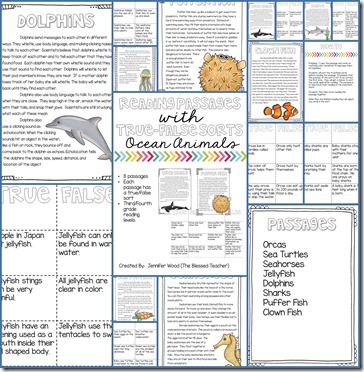
If you don’t have time to create your own you can grab my Ocean Animals Passages and Sorts.  They are high interest and between a third and fourth grade reading level. 

True-False Sort Pack (Ocean Animals) Collage

Stay tuned for other themed sorts…there are more to come!  Happy Sorting!

Sunday, November 1, 2015

Problem Solving Made Less Painful!

If your math assessments are anything like ours they have a lot of short answer, problem solving, explain your thinking type problems included.  We were looking for a way to get our students to work through problems and explain how they arrived at their answer.  Enter R.I.C.E. Check, courtesy of my brilliant friend Mrs. Nelson (who is NOT missing, she just moved to Kansas). 

Mrs. Nelson was my teaching partner for several years before moving and becoming an instructional coach at a very lucky school in Kansas.  She flies out to sunny AZ at least twice a year and we get to hang out, go for walks/hikes, and chat all things school.

On one of our walks we were chatting about how to get students to explain their mathematical thinking in writing and she shared her genius idea of Rice Check!  After having used it and tested it out for two years now, I asked her if I could share it with you on my blog and she graciously said yes! 

Slide2

The day that I introduce R.I.C.E. Check to my students I give them a little snack of Rice Chex to get them interested!

Slide1

I’m not sure what it is about including food that gets them so excited, but it works.  They seem to remember how R.I.C.E. Check works so much better since they get to eat while learning about it. 


Slide1


To start them off, I make an anchor chart that hangs on our math wall and then give them a small copy to glue into their math notebooks.


Slide2

The first SEVERAL times we use R.I.C.E. Checks we do it together as a class.  Modeling how to use it and sharing your thinking with your class is such an important step.  I also use it during small group instruction during math centers so I can work with them a little more closely on it!

Slide3

This is my second year using R.I.C.E. Checks with my students.  In the last two years I have seen how successful this strategy is.  On our framework assessments, students who use R.I.C.E. Checks to solve the short answer problems and explain their thinking earn all of the points on the rubric.  In order to get enough practice, we glue in a week’s worth of problems into our math journal.  We warm up for our math time each day by problem solving.  Once they get the hang of it, they can usually get finished in about 15 minutes.  I collect their journals every Friday and check one of the problems.  I never tell them ahead of time which problem I will be checking, it keeps them on their toes! 

Slide4

I think the most important part of our problem solving time is the time we spend sharing our thinking.  My students love to pair share and see all of the different strategies they used to solve the same problem.  Allowing them time to discuss their thinking, talk about strategies that they were successful with, as well as those they tried and abandoned is such an important step.  They learn so much from each other.

If you would like to try R.I.C.E. Check with your students go grab the pack for FREE from my TPT store {Click HERE}. It has everything you need to get started!

cKWkAz

Happy Problem Solving!

Friday, October 2, 2015

October 2GetherWeAreBetter

I’m so excited to be linking up with two of my favorite bloggers, Ashley and Angie, for a linky about one of my favorite subjects….math!
math games banner.001


I am so excited to share 2 of my favorite math strategies for this month’s 2getherwearebetter!


Slide2


Two to three times a week we begin our math time with problem solving journals.  I project a problem on the smart board.  I try to write the problems using my students’ names and they love when I find Melonheadz that look like them!


Slide1

I give them quiet problem solving time.  While they are working, I make the rounds encouraging and coaching as needed.  The important thing is that we are working on our perseverance.  We are working on not giving up if the first strategy we try doesn’t work, we are working on checking to make sure our answer is reasonable and makes sense.  We are working on explaining our thinking and constructing viable arguments.  We work on modeling mathematics and use appropriate tools. Sound familiar?  Our problem solving routine covers 7 of the 8 mathematical practices!
  Slide3Slide2


During our quiet problem solving time students can use any tool available to help them.  I have bins set up with different kinds of math manipulatives and tools.  After quiet time we take our journals and walk around the room doing pair share.  They take turns explaining how they solved the problem.  If they don’t have a solution yet they talk through all of the strategies they’ve tried.  It’s amazing to hear them talk about their thinking with each other.  It’s also amazing to hear them coach each other through struggles and offer each other ideas!


My other favorite strategy is one of my favorite parts of our day!


Slide1


If you never heard of Number Talks I highly recommend checking them out.  I am in love with them.  My kids are in love with them.  I had two groups of visiting teachers in my room this week to observe our Number Talks and they loved them and couldn’t believe the vocabulary my kids were using and how they were discussing their thinking! 


You can read about my love for Number Talks in a previous post HERE.


Here is what our board looked like after our Number Talk today.


Slide4


We have been busy adding to our Number Talk Tool Box this week too. 


Slide5


Again, this strategy hits 7 of the 8 mathematical practices.  And to hear your kids saying things like, “I decomposed the number 88 into 80 and 8….,”  and asking each other questions like, “Can you explain why you subtracted 6 at the end?”  is the most amazing thing ever! 


You can check out the Number Talks book HERE and be sure to check out my previous post!


I’m so excited to go read about some other great math games and strategies!